How are we already starting spring break? This semester is flying by so quickly! This week, we studied accountability. The students learned what accountability is and explored some examples in the YESS Institute workbook. Then, I introduced the Accountability Ladder, which treats accountability as a spectrum. Take a look at the image below to see what it looks like.
Once the kids had a basic understanding of the Accountability Ladder, they shared their own accountability stories with their mentors/mentees. Next, I provided each student with a handout on which they would draw a picture or tell a story about a time when they had an opportunity to be accountable. When they completed their handout, they placed it on the correct rung of our classroom accountability ladder.
To complete the conversation, I asked the students to analyze each handout to see if it was placed in the appropriate place on the ladder.
Friday, March 27, 2015
Friday, March 20, 2015
March 16th - 20th
Like last week, this one seemed short due to testing and a field trip. Happily, the students were mostly positive in class and accomplished much. Early in the week, they were tasked with finishing their Love Cup project and, as usual, I was impressed with their creativity. Take a look at some of my favorites below!
We also worked on a mini-project that involved what mentoring means to the kids. I had done something similar with the mentors prior to the mentees' arrival so I thought I knew what the kids would say, but it was really interesting to see how the mentors' opinions have changed since January. Getting the mentees' perspectives was enlightening, as well. As we discussed words that are associated with mentoring, some common themes like positivity, loyalty, kindness, and responsibility popped up.
Friday, March 13, 2015
March 9th - 13th
This week, we began our first round of PARCC tests, which meant we were on a weird schedule for several days. The kids worked hard on the test, but seemed to be out-of-sorts for their other classes. Because of this, we took it easy and focused on strengthening the bond between mentors and mentees by playing games and starting a project called "Love Cup." The love cup assignment is allowing the students to ponder what "fills them up" and what "drains" them. Once they've completed the artistic portion, I've asked them to write a paragraph. Take a look at some of the kids working below!
Friday, March 6, 2015
Martch 2nd - 6th
This week, we continued examining our emotions and how they affect our lives by identifying unhelpful thinking styles, which is a concept I borrowed from Cognitive Behavioral Therapy techniques. If you'd like to see the list, as well as useful descriptions, click here.
I created several games and activities that allowed the students to reflect on their own thinking and name which ones they use. The first activity was a simple matching game. The students found it rather difficult, but it led to insightful conversations about how the same thoughts could fall into several different thinking style categories.
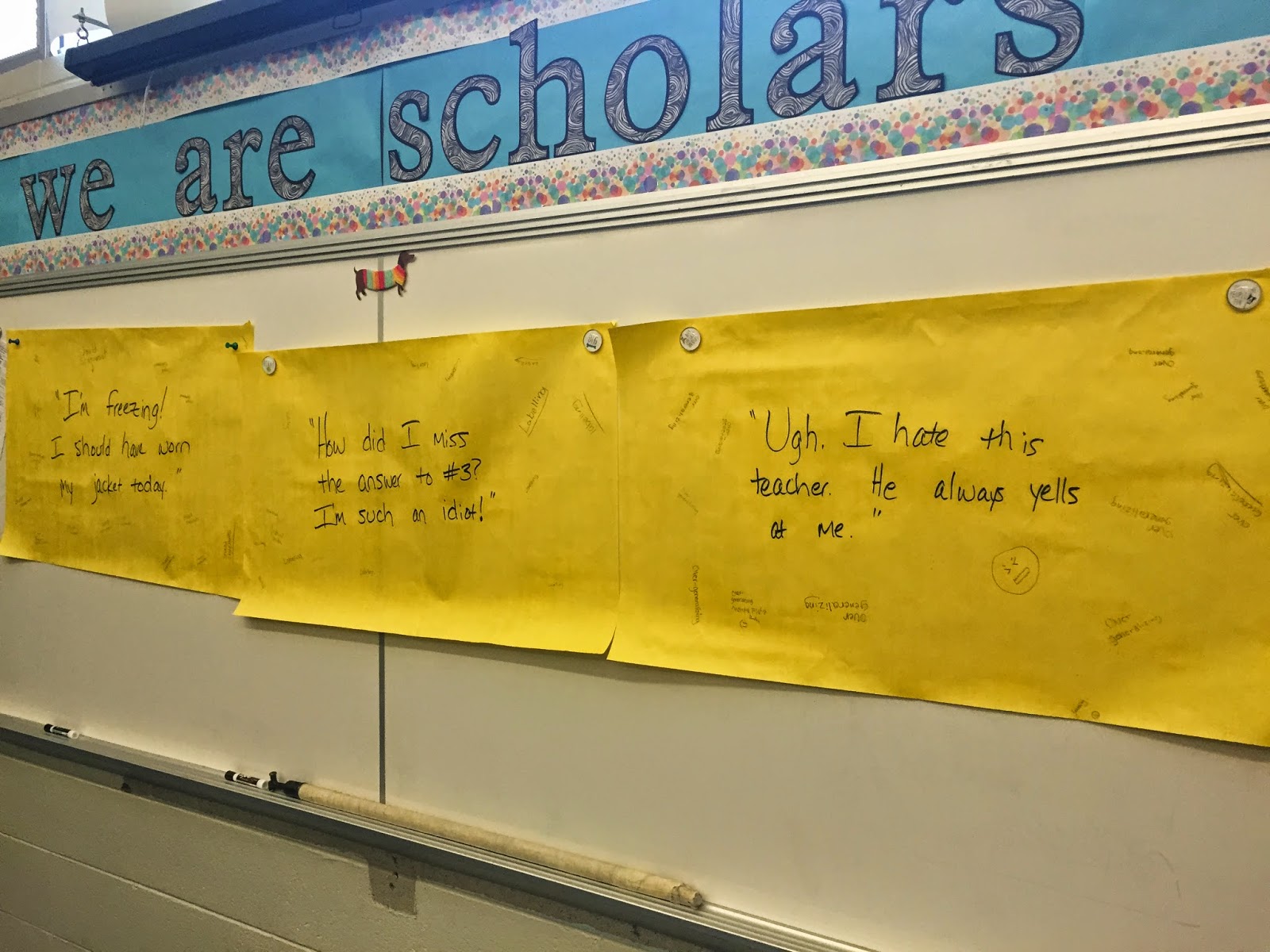
The next activity built on the matching game and is based on an idea presented at one of SCMS's professional development days. I created three posters, each with one statement. The students were instructed to walk to each poster and guess which thinking style was being used.
I also created a quiz game so the students could strengthen their understanding of the thinking styles. The kids really enjoyed playing. Moreover, they loved discussing why some thoughts were categorized as one thinking style as opposed to another and we had fabulous debates.
This was an extremely productive week for the YESS participants. Now that the students know how to identify their unhelpful thinking styles, I'm looking forward to guiding the kids through ways to challenge their unhelpful thoughts.
I created several games and activities that allowed the students to reflect on their own thinking and name which ones they use. The first activity was a simple matching game. The students found it rather difficult, but it led to insightful conversations about how the same thoughts could fall into several different thinking style categories.
The next activity built on the matching game and is based on an idea presented at one of SCMS's professional development days. I created three posters, each with one statement. The students were instructed to walk to each poster and guess which thinking style was being used.
I also created a quiz game so the students could strengthen their understanding of the thinking styles. The kids really enjoyed playing. Moreover, they loved discussing why some thoughts were categorized as one thinking style as opposed to another and we had fabulous debates.
This was an extremely productive week for the YESS participants. Now that the students know how to identify their unhelpful thinking styles, I'm looking forward to guiding the kids through ways to challenge their unhelpful thoughts.
Friday, February 27, 2015
February 23rd - 27th
This week, the students explored the wild world of emotions and how our Limbic System can take over our ability to think rationally, which is controlled by the Cerebral Cortex. To do that, I set up a multi-day lesson that demonstrated our brain biology and how our bodies react to what we're thinking and feeling. On the first day, we identified the seven primary emotions: joy, fear, sadness, disgust, anger, shame, and compassion. We also practiced distinguishing the difference between thoughts and feelings, as well as the difference between thoughts that are facts and thoughts that are opinions. You can test your skills by following the links here and here.
The second day, we began watching a short horror movie called "The Quiet." Students were instructed to monitor their emotions as they viewed the film and we stopped periodically to discuss the feelings the characters were displaying, as well as the students' emotions and the biases they were observing. If you'd like to see the twenty-minute film, click here. It was great to see the kids so engaged with the plot. At the end, we mapped out the level of fear being experienced by the main character and pondered how the movie would have been different if her Limbic System hadn't taken over her rational Cerebral Cortex.
Today, the final day of the lesson, we continued our conversation around the film and how the characters' emotions affected their behaviors. We also began discussing how we can control our emotions by thinking a certain way and staying logical in the face of adversity. This series of lessons is meant to supply background knowledge for the rest of the YESS curriculum, since I noticed many of the kids were unable to identify emotions.
The second day, we began watching a short horror movie called "The Quiet." Students were instructed to monitor their emotions as they viewed the film and we stopped periodically to discuss the feelings the characters were displaying, as well as the students' emotions and the biases they were observing. If you'd like to see the twenty-minute film, click here. It was great to see the kids so engaged with the plot. At the end, we mapped out the level of fear being experienced by the main character and pondered how the movie would have been different if her Limbic System hadn't taken over her rational Cerebral Cortex.
Today, the final day of the lesson, we continued our conversation around the film and how the characters' emotions affected their behaviors. We also began discussing how we can control our emotions by thinking a certain way and staying logical in the face of adversity. This series of lessons is meant to supply background knowledge for the rest of the YESS curriculum, since I noticed many of the kids were unable to identify emotions.
Friday, February 20, 2015
February 18th - 20th
Even though the week was only three days long, the scholars at Scott Carpenter Middle School worked hard. On Wednesday, the students began taking a personality quiz that would allow them to explore how their personality traits worked to help or hinder their relationship with their mentor or mentee. In order to facilitate an in-depth exploration, we took two days to complete the activity. By the end, students were able to discuss their personality types, as well as effective means of communication with their partners.The remaining day was spent working on tutoring and homework help. Take a look at some of the worksheets and handouts the students used!
Friday, February 13, 2015
February 9th - 13th
So far, nothing spooky is happening at SCMS on this Friday, the 13th. The staff and students are looking forward to a long weekend after a great week filled with fun activities and parent/teacher conferences.
The YESS Institute students completed two projects, in addition to their
small-group session on Monday and their homework help day on Thursday.
The first activity they completed was the Life Map, which they had
started last week. For this project, each student was asked to create a
timeline of their life and write a paragraph to explain the events they
chose to include. The goal was to allow them to explore their history
and how past experiences may affect their current lives. As usual, I was
impressed with the kids' creativity and thoughtfulness!
All the YESS Institute participants created Hand Contracts this week, as well. For this activity, we discussed how to set good goals and how to use objectives as "mini-goals," which are intended to help achieve the broader aim. Once the criteria for goals and objectives were set, the mentors assisted their mentees in setting goals for their time in YESS.
Next week, time is short, but we'll be making the most of it by exploring thought patterns and the differences between thoughts and emotions.
All the YESS Institute participants created Hand Contracts this week, as well. For this activity, we discussed how to set good goals and how to use objectives as "mini-goals," which are intended to help achieve the broader aim. Once the criteria for goals and objectives were set, the mentors assisted their mentees in setting goals for their time in YESS.
Next week, time is short, but we'll be making the most of it by exploring thought patterns and the differences between thoughts and emotions.
Subscribe to:
Posts (Atom)